
Architectural Signage Guide
Dimensional Metal Letters vs. Channel Letters: Which Architectural Sign Is Right for Your Building?
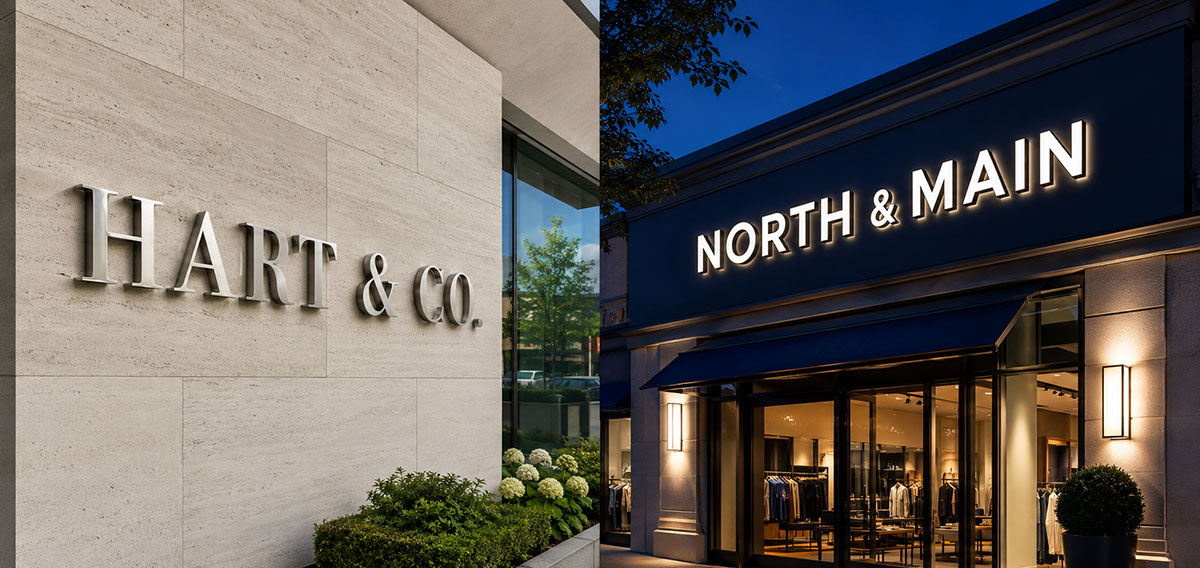
Somebody on your project asked for “dimensional letters,” somebody else asked for “channel letters,” and now you’re trying to figure out if those are two names for the same sign or two completely different products. They’re not the same thing, and the difference matters more than it looks like at first glance: it changes your budget, your electrician’s scope of work, and in some cases whether your city will even permit the sign.
Short version: dimensional letters are solid metal, with no electrical cavity, and rely on ambient or external light to be seen. Channel letters are hollow, built like a shallow box, and light themselves from the inside. Everything else in this guide (cost, code compliance, maintenance) flows from that one construction difference.
What’s the Actual Construction Difference
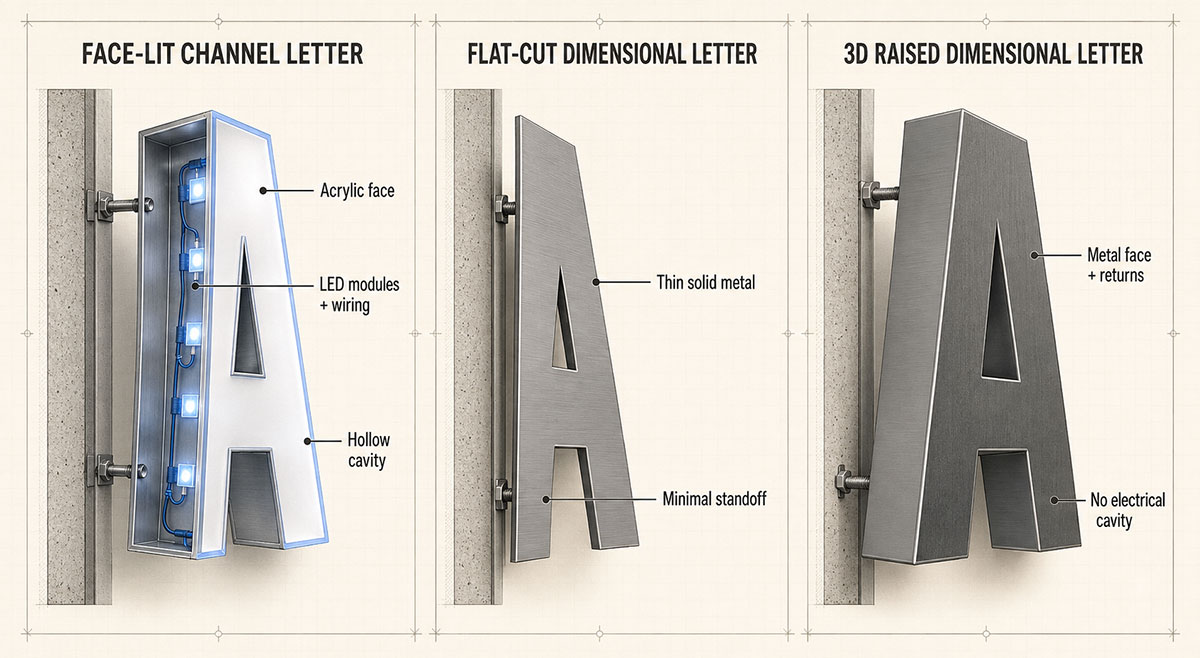
A channel letter is built like a tray. Aluminum forms the sides (the “returns”), a plastic acrylic or aluminum face caps the front, and the inside is hollow, and that’s where the LED modules and wiring live. Picture a shoebox in the shape of the letter “A,” open on one side, with the electronics tucked inside before the face goes on. That hollow channel is where the name comes from.
Dimensional letters come in two forms, and both are solid, meaning no cavity, no wiring channel, nothing inside, but they don’t have to be flat. Flat-cut dimensional letters are exactly what they sound like: a thin sheet of metal, usually stainless steel or aluminum, cut to the letter shape and mounted a half-inch to an inch off the wall on studs.
3D raised dimensional letters are fabricated the same two ways, stainless steel or aluminum, but with metal sides added, the same kind of “returns” a channel letter uses, welded or formed onto the face to build real depth, often 1 to 3 inches, sometimes more for a dramatic “floating” look. From the front, a well-made raised dimensional letter can look almost identical to a channel letter.
The difference is what’s behind the face: a channel letter has an open cavity packed with LEDs and wiring, and a raised dimensional letter has either solid backing or nothing at all back there: just formed metal, no electronics. Both forms of dimensional metal letters are available in stainless steel or aluminum.
That’s the real dividing line, and it’s not about how flat or deep the letter looks. If a sign has an internal electrical cavity, it’s a channel letter. If it’s shaped metal, flat or dimensional with returns, with no electronics inside, it’s a dimensional letter, whether anyone on the project calls it that or not.
“Dimensional signage” as a category actually covers a wider range of materials (acrylic, foam, PVC dimensional letters exist too), but when the material is metal specifically, “dimensional metal letters” and “metal channel letters” both get used loosely online for the same non-illuminated product, which is exactly why this comparison keeps coming up.
Illumination: Internal LED vs. Relying on Existing Light
This is where the cost and complexity actually diverge.
Channel letters carry their own light source. LED modules are mounted inside each letter and wired to a UL-listed power supply, which needs one electrical feed run to the sign location. That means an electrician is part of the installation, even on a plug-and-play kit where every letter arrives pre-wired, because someone still has to land that one power connection.
Dimensional metal letters need none of that. There’s no power feed, no power supply, no LED modules, no electrical inspection tied to the sign itself. The letters mount directly to the wall with studs or standoffs and that’s the entire installation. The tradeoff is visibility after dark: a solid metal letter is only as readable at night as the light already falling on it. In a well-lit lobby, parking structure, or building entrance, that’s often plenty.
On a dim building face with no ambient light, dimensional letters can become hard to read once the sun goes down, and the fix is external fixtures such as gooseneck lights, recessed can lighting, or landscape uplighting aimed at the sign, which is a separate line item from the sign itself, not something built into the letters.
So the practical question isn’t “which type has better lighting.” It’s “does this location already have light on it, or does someone need to add some.” If the answer is no reliable light source and the sign needs to read at night, that’s usually the moment a job shifts from dimensional letters to channel letters, or to specifying exterior fixtures as part of the same scope.
Cost and Maintenance Comparison, Side by Side
Here’s how the two types compare over time. These are ballpark ranges for a typical single-line building sign. Your actual numbers will move with letter size, count, and local electrician/electricity rates, but the pattern holds regardless of scale.
| Cost Factor | Dimensional Metal Letters | Channel Letters (Face Lit) |
|---|---|---|
| Upfront fabrication | $500 to $1,800 | $800 to $2,500 |
| Electrical hookup | None required | $200 to $600 (licensed electrician, one power feed) |
| Electricity, 10 years (~12 hrs/night) | $0 | Roughly $1,000 to $2,500, depending on sign size and local rates |
| Component replacement, 10 years | None, no electrical parts to fail | Power supply may need one swap (about $100 to $200); LED modules are rated 50,000+ hours and rarely fail within a decade |
| Ongoing maintenance | Occasional cleaning; painted aluminum may need refinishing once every 8-10 years | Occasional cleaning; acrylic face color can fade slightly under intense UV over a decade |
| Estimated 10-year total cost of ownership | $600 to $2,100 | $2,100 to $5,800 |
The gap isn’t really about which sign is “cheaper” in a vacuum. It’s that dimensional letters have almost no electrical footprint to maintain, and channel letters have an ongoing (small) electricity cost plus a slightly higher chance of a component needing attention over a decade of use. For a full breakdown of what drives channel letter pricing up or down in the first place (letter height, illumination type, finish, mounting), see the channel letter sign cost guide.

Which Buildings and Sign Codes Favor Each Type
Dimensional Letters Tend to Win When:
Channel Letters Tend to Win When:
If you’re not sure which category your building or municipality falls into, that’s a five-minute question for your local planning or zoning office before you spec anything, because permit rules vary by city and this guide can’t tell you what your specific address allows.
Decision Checklist: Which One to Request a Quote On
Run through these in order. The first one that applies usually settles it:
Already know your letter shapes and layout? Our online sign designer lets you build it out yourself and see it before you order.
Frequently Asked Questions
Not Sure Which One Fits Your Building?
Ready to Spec Your Sign?
If you already know illuminated signage is off the table for your building (a historic district, a landlord covenant, an office lobby that doesn’t need to compete for nighttime attention), dimensional metal letters in stainless steel or aluminum are worth requesting a quote on.
If your location needs to be read after dark and there’s no light already on the wall, channel letters are the better starting point. Not sure which one your address, budget, or sign code actually points to? Request a free quote below and tell us about the building, and we’ll tell you which type makes sense before you spend anything on artwork.