
Raceway Mount vs. Flush Mount Channel Letters: Which Installation Saves You Money (and Passes Inspection)?
Channel Letter Blog · UL Certified · Factory-Direct · Nationwide Shipping
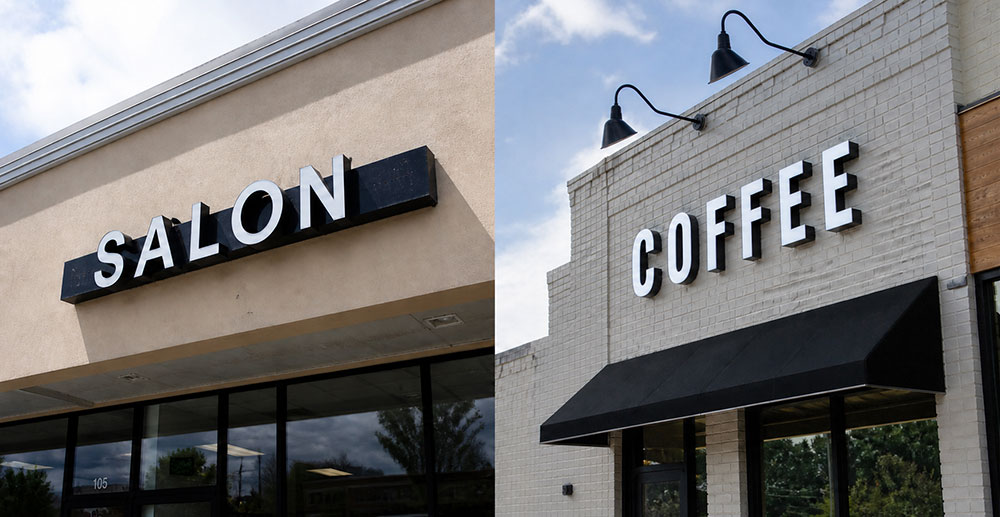
If your sign quote came back with two different totals for what looks like the same set of letters, this is almost always why: one is for raceway mount, the other is for flush mount, and the real difference isn’t one lump number, it’s three separate factors moving in different directions at once — fabrication, installation, and shipping. Nobody explains this up front, so business owners end up picking whichever total is smaller without knowing what they’re trading away, and sometimes that trade-off is a failed inspection or a call from the landlord asking why there are drill holes in their EIFS.
Short version: raceway mount puts your letters on a metal box that holds the wiring and bolts to the wall as one unit. Flush mount skips the box and puts each letter, and every wire, directly into the building’s face. One protects your wall and your budget. The other looks cleaner but asks more of your facade and your wallet. Which one is “better” depends entirely on what your building is made of and what your landlord or inspector will actually allow, not on which one looks nicer in a rendering.
Raceway and flush aren’t the only two mounting methods out there, they’re just the two that come up most often on cost and inspection questions. For the full rundown of every way channel letters can mount to a building, see our complete guide to channel letter mounting options.
What Raceway Mounting Actually Is
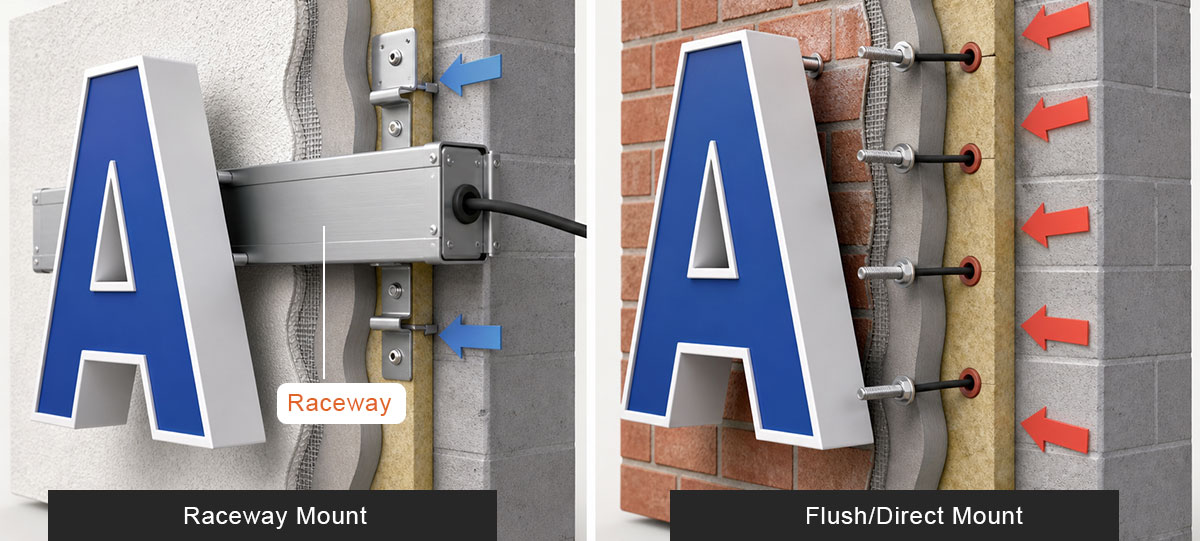
A raceway is a rectangular metal channel, usually aluminum, that runs behind your letters and does two jobs at once: it houses all the wiring and the power supply, and it gives the installer a single, pre-wired unit to lift and bolt to the wall instead of dozens of individual letters and loose wire runs.
Here’s how it goes together in practice. The sign shop builds your letters and mounts them onto the raceway in the shop, under controlled conditions, with every wire already run and tested. On install day, the crew shows up with one assembly, not a box of parts. They mark the mounting points, drill a handful of holes for the raceway’s mounting brackets, run one power feed into the raceway, and bolt it to the wall.
Because every letter is already wired and secured to the raceway before it ever reaches the building, there’s no drilling into the wall behind each individual letter, only the drilling needed to hang the raceway itself, which is a fraction of what flush mounting requires.
The trade-off is visual: the raceway is visible as a box behind or below the letters, usually painted to match the building or a similar dark neutral, but it doesn’t disappear the way flush-mounted letters do. Most raceways run the width of the sign and sit a few inches proud of the wall, which some property managers care about and most everyday customers walking or driving by never notice.
What Flush (Direct) Mounting Actually Is
Flush mount, sometimes called direct mount, skips the raceway entirely. Each letter gets its own set of mounting studs welded to the back, and the installer positions every letter individually, directly on the wall, using a template to keep spacing and alignment consistent. Wiring runs behind the wall itself, through holes drilled for each letter, back to a power supply that’s typically hidden in an attic space, a soffit, or mounted discreetly nearby.
The payoff is the look: no visible housing, no box, just letters that appear to float directly on the building. It’s the cleaner, more premium appearance that a lot of business owners picture when they imagine channel letters on their storefront.
The cost of that look is what happens to the wall. Flush mounting requires drilling into the facade behind every single letter, sometimes multiple holes per letter for mounting studs plus a separate penetration for wiring, and the wall has to be structurally capable of holding weight on secure hardware, wire-fished internally, and sealed properly against water intrusion at every one of those points.
On a straightforward brick or solid stucco wall with attic or interior access behind it, that’s a manageable job for an experienced crew. On the wrong wall type, it turns into a much bigger job than the sign itself, which is exactly what the next two sections cover.
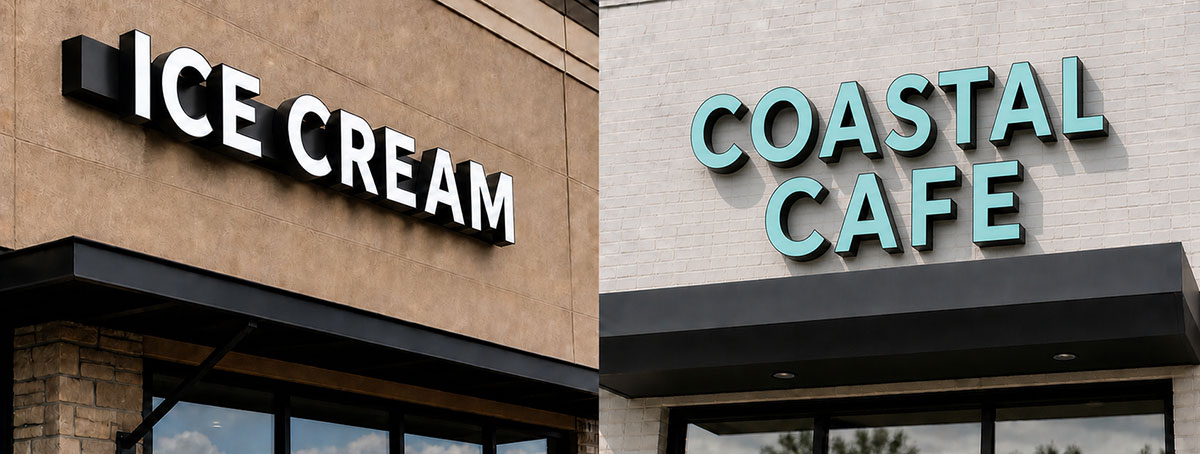
Cost Difference: Fabrication, Installation, and Shipping
Here’s the real-world cost comparison for a typical single-line storefront sign, letters roughly 12 to 24 inches tall, installed on a standard commercial facade with reasonable access. These are ballpark ranges. Your actual number moves with letter count, wall height, wall material, sign size, and local labor rates, but the pattern below holds regardless of scale. Three separate factors are at play here, and they don’t all point the same direction.
| Cost Factor | Raceway Mount | Flush Mount |
|---|---|---|
| Fabrication (the letters and sign itself) | Higher — add roughly $400 to $1,000 for the raceway box, hardware, and shop time to mount letters onto it | Lower — no raceway box to build, just the individual letters |
| Installation (labor + equipment) | Typically the lower end of $800 to $2,200 — one pre-wired assembly, fewer wall penetrations, usually a standard ladder or lift | Typically the higher end of $800 to $2,200 — each letter positioned, drilled, wired, and sealed individually |
| Installation equipment risk | Can jump above that range if the sign’s size or weight requires a bucket crane instead of a ladder or lift | Rarely requires anything beyond a ladder, even on larger signs, since letters install one at a time |
| Shipping | Generally higher — ships as one long, rigid, pre-assembled unit that’s harder to crate efficiently and often pushes into freight/LTL territory | Generally lower — individual letters nest and crate more compactly; exact gap depends heavily on sign size and which shipping method the size forces |
| Wall penetrations required | A handful (raceway mounting brackets only) | One or more per letter, often 15 to 40+ holes on a multi-letter sign |
| Wall sealing/waterproofing scope | Limited to raceway mounting points | Every individual penetration needs to be sealed, a much larger point-of-failure list |
Notice that fabrication and shipping both favor flush mount, while installation usually favors raceway, unless that raceway is big or heavy enough to need a crane, at which point installation can flip in flush mount’s favor too. That’s why there’s no single “cheaper” answer here the way a lot of sign shops present it. A small raceway sign on a standard ladder install can land close to flush mount’s total cost once you add up all three factors.
A large, heavy raceway spanning a wide storefront, one that needs a crane and freight shipping, can end up costing noticeably more than flush mount overall, even though its installation labor hours are lower. Ask your sign company to break the quote out by these three factors, not just a single install number, so you can see which one is actually driving your total.
The Structural Problem No One Warns You About
Before you pick flush mount because it looks better in a photo, the facade itself has to be able to support it, and this is the step a lot of first-time sign buyers skip until an installer shows up and finds out on-site.
EIFS (synthetic stucco) is the big one. EIFS, sometimes just called “stucco” even though it’s a different system, is a foam insulation board with a thin, brittle finish coat over it, not a structural material. Drilling directly into EIFS for flush-mounted letters, without the right backing, means your mounting hardware is anchored into foam, not into anything load-bearing, and that’s a recipe for letters that sag, shift, or pull loose within a year or two, plus water intrusion at every hole since EIFS is notoriously unforgiving about penetrations that aren’t sealed exactly right.
Flush mounting on EIFS is possible, but it requires either locating and anchoring into the structural wall behind the foam (which means longer fasteners and precise blocking) or adding backer plates, and either way it adds cost and risk that a straightforward brick or concrete wall doesn’t have. Raceway mounting sidesteps almost all of this because it distributes the load across a handful of engineered mounting points instead of dozens of individual letter penetrations.
Traditional hard-coat stucco and brick or CMU (concrete block) are generally solid, structural substrates and handle flush mounting well, as long as the installer uses the correct anchors for masonry.
No-stud or open-frame facades, common on some metal building storefronts or older strip-mall facades, are the other trap. If there’s no solid backing directly behind where a letter needs to mount, either because it’s open framing, thin metal panel, or a hollow soffit, flush mounting means either finding and hitting actual studs (which rarely lines up with where the letters need to go) or adding blocking behind the wall before the sign ever goes up, which is its own separate contractor cost.
How to check before you order: ask your sign company what the building’s exterior wall material is (EIFS, brick, hard-coat stucco, metal panel, wood) and whether there’s solid backing at the mounting height. A five-minute question before fabrication avoids a change order or an installer standing at your building with a sign they can’t hang the way it was designed.
Which Mount Your Landlord Will Likely Require
If you’re leasing your space, the mounting method may not actually be your call; it’s your landlord’s, and this comes up more than most tenants expect.
Property managers and landlords, especially in multi-tenant retail centers and office parks, frequently mandate raceway mounting specifically because it protects the building envelope. Fewer wall penetrations means fewer opportunities for water intrusion into the wall assembly, which is the property owner’s liability once the tenant moves out and the next one takes over the space.
A raceway can also be removed and the wall patched in a handful of spots when a tenant leaves; a flush-mounted sign with 30 individual penetrations is a much bigger patch-and-repaint job for the landlord to deal with on turnover, and building owners know this from experience even if the incoming tenant doesn’t.
Some lease agreements spell this out explicitly in the signage criteria section (worth reading before you finalize your sign design), and some landlords simply have an informal preference they’ll voice the moment they see a flush-mount proposal. Either way, it’s worth asking your landlord or property manager directly, before you pay for fabrication, whether raceway mounting is required. It’s a much cheaper conversation to have upfront than a conversation after your flush-mounted sign is built and the property manager asks you to redo it.
Municipal sign permitting is a separate, and separately important, check. Some cities’ sign codes reference mounting method for wind load or structural sign-off purposes, particularly for larger letters or taller buildings, so your local permitting office is worth a call regardless of what your landlord requires, since permit rules vary by city and this guide can’t confirm your specific jurisdiction’s requirements.
Which One Should You Choose? A Quick Decision Guide
Run through these in order. The first one that applies usually settles it:
- Does your lease or property manager require raceway mounting? → Raceway. This overrides everything else; check before you design anything.
- Is your building’s exterior EIFS, thin metal panel, or open-frame with no solid backing? → Raceway, unless you want to pay for structural blocking or backer plates on top of the sign cost.
- Is budget the deciding factor and the letters don’t need to look “flush” for brand reasons? → Get quotes for both. Raceway usually installs cheaper and looks fine for most storefronts, but flush mount is usually cheaper to fabricate and ship, so on a smaller sign the two totals can land close together, or flush can even come out ahead once shipping is factored in.
- Is this a flagship or high-visibility location where the fully flush, no-visible-housing look matters to the brand, and the wall is solid brick, block, or hard-coat stucco? → Flush mount is realistic here, budget for the added labor and sealing work.
- Not sure what your wall is made of or what your local code requires? → That’s exactly what requesting a quote is for. Tell us your building type and, if you have one, a photo of the wall, and we’ll tell you which mount fits before you spend anything on fabrication.
Already have your letter layout figured out? Build it in our online sign designer and we’ll flag mounting considerations when we quote it.
Frequently Asked Questions
Ready to Spec Your Installation?
If your landlord requires raceway mounting or your building is EIFS or open-frame construction, raceway protects your wall and may not be optional. If budget is the deciding factor, get quotes for both, raceway usually installs cheaper, flush mount usually fabricates and ships cheaper. If the fully flush look matters for a flagship location on solid brick or block, flush mount is realistic.