
Sign Design & Lighting
Front-Lit vs. Halo-Lit Channel Letters: The Real Difference in Night Visibility and Energy Cost
Short answer
Face-lit (front-lit) letters throw more raw light and read from farther away, halo-lit (backlit) letters read as more upscale but need a dark wall or a spacer gap to actually work, and the energy difference between them is small enough that it should almost never be the deciding factor. The deciding factor is almost always what look fits your building and your brand, and what your storefront’s lighting conditions will actually let read well after dark.
We get this question on close to every quote call for an illuminated sign, usually phrased as “which one’s better,” and the honest answer is that they’re solving different problems. This post walks through how each type actually produces light, how far away each one reads at night, what they really cost to run, which industries lean which way and why, and what the full 10-year cost looks like once you add installation and maintenance to the electric bill.
Quick Answer
Pick for the way customers actually find you.
Drive-by traffic and light-colored walls usually point toward face-lit. Foot traffic, dark walls, and premium brand positioning open the door to halo-lit or combo-lit letters.
How Each Type Produces Light
Face-Lit
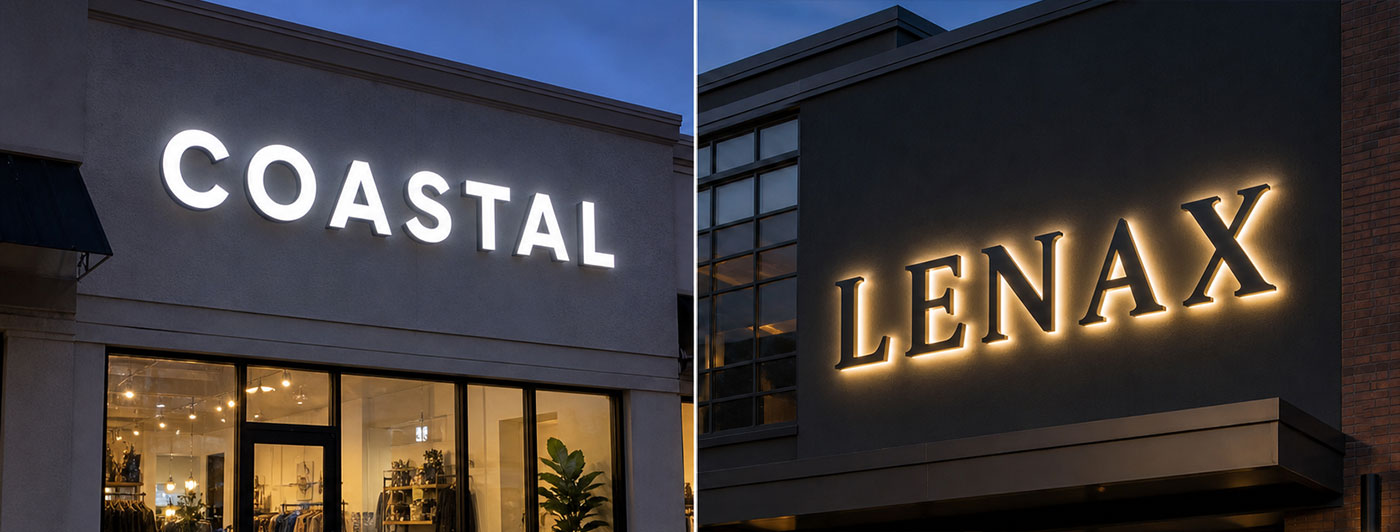
Face-lit (front-lit) letters are the classic channel letter look. The letter is built as a metal can, usually aluminum, with a translucent acrylic face on top. LED modules sit inside the can, mounted to the back wall, and the light shines forward through the acrylic face. The face itself is what you see lit up, in whatever color the acrylic (or a printed vinyl overlay) is. This is the sign most people picture when they hear “channel letter sign,” and it’s the standard on the vast majority of storefronts.
Halo-Lit
Halo-lit (backlit, reverse-lit) letters flip the construction around. The letter face is solid, usually opaque aluminum with no acrylic, and the LEDs sit inside the can facing backward, toward the wall. The letter itself stays dark. What you see is a glow that spills out from behind the letter and washes across the wall in a halo around its shape, which is where the name comes from. You’ll also hear these called reverse channel letters, since the light throw is reversed from a standard face-lit can.
The construction difference is also why halo letters have a strict requirement face-lit letters don’t: standoff distance.
Install note
A halo letter needs to sit roughly half an inch to an inch off the wall, on hardware spacers, so light can actually spill out from behind it. Mount a halo letter flush against the wall and the glow has nowhere to go, the halo effect disappears, and you’ve paid for a reverse-lit sign that looks like a dark shape during the day and barely lit at night. This is one of the most common installation mistakes we see on halo jobs done by shops that don’t build them often.
Night Visibility: Readable Distance at Road Speed
This is where the two styles actually diverge, and it’s not subtle.
A face-lit letter is a direct light source pointed straight at the viewer. At night, from a car moving at 35-45 mph, a well-sized face-lit sign (letters in the 18-24 inch range, which covers most storefronts) is legible from roughly 250 to 300+ feet away, depending on letter color and background contrast. White or amber acrylic faces read the farthest; deep reds and blues lose some punch because the acrylic itself absorbs more light before it reaches the face.
A halo-lit letter is indirect by design, you’re reading reflected light bouncing off the wall around a dark shape, not a lit surface. That’s a fundamentally dimmer signal. On a dark or matte wall with good contrast, a halo sign of the same letter size is legible from roughly 100 to 150 feet, sometimes less. On a light-colored or reflective wall (white stucco, light brick), the halo effect washes out almost entirely and can be close to unreadable at any real distance, because there isn’t enough contrast between the glow and the wall it’s glowing on.
That gap matters most for anyone counting on the sign to be found by drive-by traffic after dark, a restaurant on a commercial strip, a retailer near a highway exit, anything where the customer is searching for you at 40 mph and has a couple of seconds to spot the storefront. For that use case, face-lit wins on raw visibility, and it’s not close.
Think a boutique hotel entrance, a law firm’s ground-floor office, a restaurant in a walkable downtown district where people are already on the sidewalk. At 20-50 feet, on a dark wall, a halo sign looks genuinely striking, arguably more so than a face-lit sign at that same close range, because the glow reads as premium rather than just bright.
Energy Usage and Cost Comparison
Both styles run on LED modules today, almost nobody is quoting neon anymore for new installs, so the energy story is closer than most people expect.
A typical channel letter set (say, a 10-letter storefront sign, letters averaging 18 inches tall) runs somewhere in the range of 60-100 watts total for face-lit construction, depending on letter count, size, and module density. Halo-lit letters of the same size generally run slightly lower, often 10-20% less, because the light only needs to fill the shallower gap behind the letter rather than fully illuminating a translucent face. In practice that’s the difference between roughly $6-10/month and $5-8/month in electricity for a sign running 12 hours a day at typical commercial power rates, a $1-3/month gap that will never be the reason to pick one over the other.
| Sign type | Typical wattage | Est. monthly cost* |
|---|---|---|
| Face-Lit (10-letter set) | 60–100W | $6–$10 |
| Halo-Lit (10-letter set) | 50–85W | $5–$8 |
*Running 12 hrs/day at typical commercial power rates, a $1–3/month gap that will never be the reason to pick one style over the other.
Where energy cost actually becomes relevant is module count and sign size, not lit style. A larger sign with more letters or bigger individual letters will cost more to run regardless of whether it’s face-lit or halo-lit, and that scales roughly linearly with total LED count. If minimizing operating cost is a real priority (multi-location brands running dozens of signs, for example), the bigger lever is choosing efficient LED modules and a properly matched power supply, not choosing between face-lit and halo-lit.
One more real cost difference: halo-lit letters need the standoff spacers mentioned above, which adds a small amount of hardware and slightly more installation labor per letter compared to a flush-mounted face-lit letter. It’s a modest difference, usually a few dollars per letter in materials, but worth knowing it’s not purely a wash on the installation side either.
Where energy cost actually becomes relevant is module count and sign size, not lit style. A larger sign with more letters or bigger individual letters will cost more to run regardless of whether it’s face-lit or halo-lit, and that scales roughly linearly with total LED count. If minimizing operating cost is a real priority (multi-location brands running dozens of signs, for example), the bigger lever is choosing efficient LED modules and a properly matched power supply, not choosing between face-lit and halo-lit.
One more real cost difference: halo-lit letters need the standoff spacers mentioned above, which adds a small amount of hardware and slightly more installation labor per letter compared to a flush-mounted face-lit letter. It’s a modest difference, usually a few dollars per letter in materials, but worth knowing it’s not purely a wash on the installation side either.
Need the right lighting style?
Send your storefront photo and wall color. We can show both options before production.
Brand Image: Which Industries Choose Which
This is genuinely where most of the decision gets made, more than visibility or energy cost, because the two styles read as different price points and different personalities even when the underlying sign costs about the same to build.
Face-lit tends to dominate in retail, fast casual and quick-service restaurants, auto shops, medical and dental practices, and any business that wants to be unmistakably visible and unmistakably open for business. It reads as direct, high-visibility, straightforward, exactly the impression a business wants when the goal is walk-in or drive-by traffic finding them fast.
Halo-lit shows up disproportionately at law firms, financial services offices, boutique hotels, upscale restaurants, medical spas, architecture and design firms, and corporate headquarters. It reads as restrained and premium, closer to how museum or gallery lighting reads, and businesses that want to signal “established” or “high-end” over “come in right now” gravitate toward it even knowing it won’t out-shine a face-lit sign from the road.
Face-lit tends to dominate
- Retail storefronts
- Fast casual & quick-service restaurants
- Auto shops
- Medical & dental practices
- Any business that needs to be unmistakably open
Halo-lit shows up disproportionately
- Law firms
- Financial services offices
- Boutique hotels & upscale restaurants
- Medical spas, architecture & design firms
- Corporate headquarters
There’s no wrong answer between the two on brand grounds, it genuinely comes down to which impression matches the business. A personal injury law firm on a busy commercial corridor might still choose face-lit because they need the visibility more than the polish. A five-star restaurant tucked into a walkable district might choose halo specifically because it doesn’t need to shout.
At a Glance: Which Style Fits
| Lighting Style | Typical Monthly Energy | Best Reason to Choose It | Watch-Out |
|---|---|---|---|
| Front-lit channel letters | $6 to $10 | Maximum night visibility | Can feel too bright for luxury brands |
| Halo-lit channel letters | $5 to $8 | Upscale glow and restrained look | Can wash out on light-colored walls |
| Combo-lit channel letters | Varies by build | Lit face plus halo effect | Higher build cost and complexity |
Total Cost of Ownership Over 10 Years
Sticker price on the sign itself is usually close between the two styles, halo-lit sometimes runs 10-20% higher per letter because of the added standoff hardware and slightly more labor-intensive install, but that’s a modest gap on a $1,500-$4,500 sign, typically a few hundred dollars total.
Where the real 10-year math diverges is maintenance and repair access, not the sign itself. Face-lit letters have LEDs mounted flat against the back wall behind a removable acrylic face, in most builds a technician can pop the face and swap a failed module without pulling the letter off the wall. Halo-lit letters have the LEDs facing backward, which usually means pulling the whole letter off its standoffs to service the wiring or replace a module, more labor per repair, even though the modules themselves fail at roughly the same rate either way.
Rough 10-year total cost of ownership for that same 10-letter, 18-inch storefront set, combining the sign, average electricity at 12 hours/day, and two to three service visits over a decade for module or power supply replacement, lands in a similar range for both styles, generally within a few hundred dollars of each other. Face-lit tends to land slightly lower mainly because of cheaper, faster service access, not because of energy use, which as covered above is nearly a wash.
Bottom line
The practical takeaway: don’t choose based on projected savings, the numbers are too close to matter. Choose based on which one actually gets seen the way you need it to be seen, at the distance your real customers are going to be looking from.
Making the Call for Your Storefront
If you’re still weighing it, the fastest way to decide is to answer two questions honestly. First, is your primary customer finding you by driving past at 30-45 mph, or are they already on foot or parked nearby? Second, is your exterior wall dark or light-colored, and is it flat enough for a halo glow to actually show up? Drive-by visibility and a light-colored wall both point toward face-lit. Foot traffic and a dark, flat wall open the door to halo, or to a combo-lit letter if you want both effects on the same sign.
- Is your primary customer finding you by driving past at 30-45 mph, or are they already on foot or parked nearby?
- Is your exterior wall dark or light-colored, and is it flat enough for a halo glow to actually show up?
If your storefront already carries reverse channel letters or you’re comparing the two builds in more technical depth, our guide on backlit channel letter signs covers the construction and standoff-mounting requirements in more detail.
We build face-lit, halo-lit, and combo-lit channel letters as UL-listed, factory-direct signs shipped nationwide, and we can mock up both looks on your actual storefront photo before you commit to one. Start in our online sign designer to see your building both ways, or request a free quote and tell us your wall color and typical foot or drive-by traffic, and we’ll tell you straight which style is going to actually work for your location.
Frequently Asked Questions
Ready to See Both Styles on Your Building?
Front-lit and halo-lit channel letters solve different problems, one is built to be seen from the road, the other to make a quieter, more upscale impression up close. The right call depends on your foot traffic, your wall color, and the impression your brand needs to make.
Request a free quote and tell us about your storefront, or build your sign in our online sign designer to preview face-lit and halo-lit side by side before you order.
Every sign is UL certified, factory-direct, ships nationwide, and carries a 2-year warranty.