
Signage Comparison
LED vs. Neon Signs: Energy Usage, Lifespan, and Total Cost Comparison for 2026
LED wins on power, lifespan, and repair cost, neon still has its place for a specific vintage look.
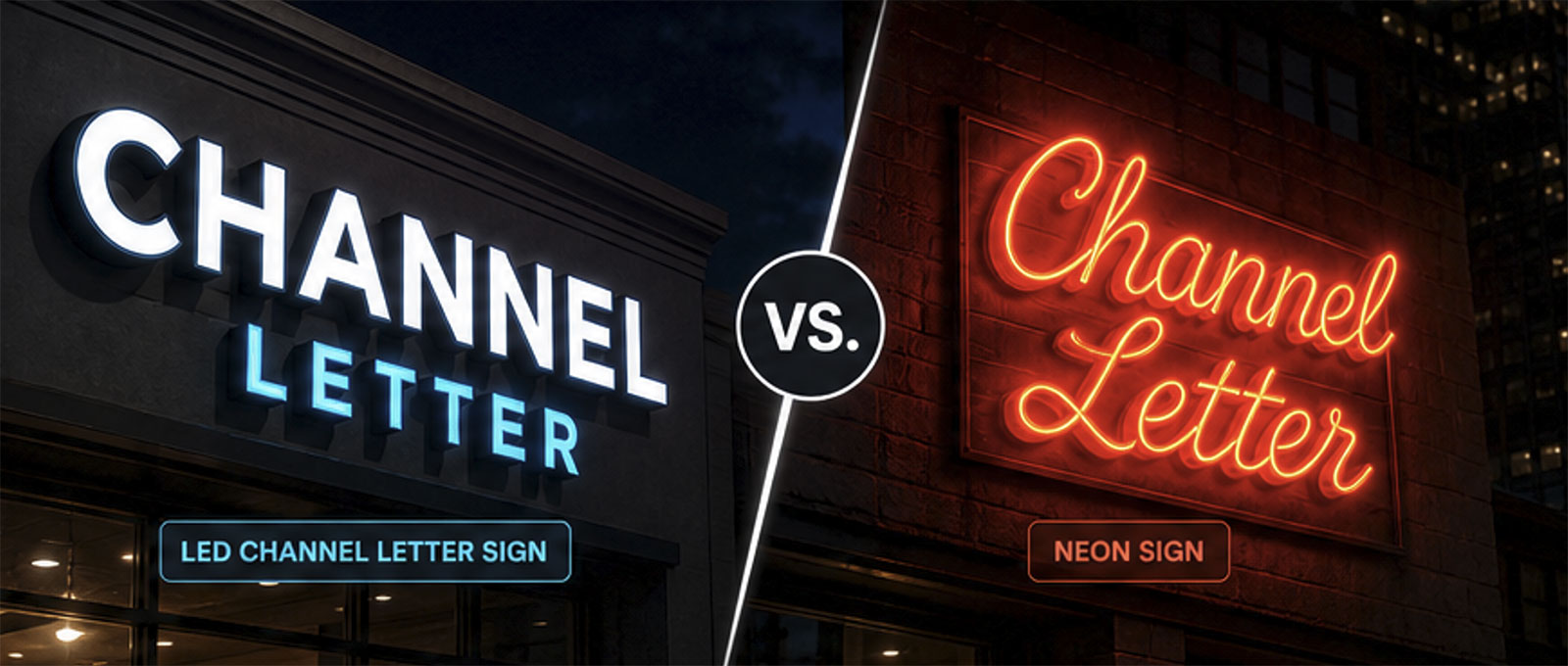
Short answer
Short answer: LED wins on almost every practical measure, it uses less power, lasts three to five times longer, and costs less to keep running over a 10-year span. Neon still has a real place, mainly for vintage storefronts, bars, and art installations where the warm glass-tube look is the whole point, but for a standard business sign, LED is the practical choice and has been for close to a decade now.
We still get asked about neon a few times a month, usually from someone opening a retro diner, a tattoo shop, or a bar who wants that specific look and assumes LED can’t do it. It can, and we’ll get into how below. But first, the actual numbers, because most of what people believe about neon’s cost and durability is either outdated or was never quite true.
At a Glance
- LED: 60-100 watts for a typical 10-letter sign.
- Neon: 150-300 watts for comparable glass tubing.
- LED: 50,000-100,000 rated hours.
- Neon: 8,000-15,000 rated hours.
How LED and Neon Actually Work
Neon signs are glass tubes bent into shape, filled with neon gas (for red/orange tones) or argon plus a drop of mercury (for blue and most other colors), then run at high voltage, typically 3,000 to 15,000 volts depending on tube length, through a transformer. The voltage excites the gas, which glows. Every color other than the classic red-orange comes from either a different gas mix or a coated (phosphor) tube, which is why true neon color range is more limited than people expect, and why a lot of “neon” signage you see today is something else entirely.
LED signs, including the channel letters we build, use solid-state diode modules wired to a low-voltage power supply, typically 12V or 24V. There’s no gas, no glass tube, and no high-voltage transformer. The light comes from the diode itself, and color is set electronically rather than by gas chemistry, which is part of why LED can hit exact Pantone or brand colors that neon simply can’t match.
The construction difference is the root of almost every practical difference between the two: glass tubing is fragile and labor-intensive to bend and seal, high-voltage transformers are a bigger failure point and a bigger safety and code concern, and solid-state LED modules have no glass, no gas, and no moving parts to fail.
Energy Consumption: kWh and Monthly Cost for a Typical Sign
This is where the gap is largest and most consistent.
Take a typical 10-letter storefront channel letter sign, letters averaging 18 inches tall, the same reference sign we use elsewhere on this site. Built with LED modules, that sign runs roughly 60-100 watts total, in line with standard face-lit LED construction. Built with neon tubing of a comparable size and letter count, the same sign typically draws 150-300 watts, sometimes more, because neon transformers themselves consume power just idling (called ballast loss), on top of what the tubes draw to glow.
Run 12 hours a day at a typical commercial electricity rate around $0.15/kWh, that’s the difference between about $3.20-$5.40/month for LED and $8.10-$16.20/month for neon, roughly a $5-11/month gap on one sign. It sounds small until you multiply it across a full storefront package (a primary sign plus a window sign or two) or a multi-location brand running the same sign design at 10, 30, or 100 locations, where the annual gap turns into real budget line items.
The gap holds even against modern neon-style products. LED neon flex (flexible LED strip in a silicone tube, made to visually mimic glass neon) narrows the gap somewhat since it’s LED-based, but it still typically draws more per foot than rigid channel letter LED modules because the strip density needed to mimic a continuous glow is higher than a channel letter’s spot-lit module layout.
Lifespan and Failure Modes
Neon tube lifespan runs roughly 8,000-15,000 hours under good conditions, sometimes cited higher by manufacturers, but that number assumes no physical damage, which is optimistic for anything mounted outdoors. Neon’s real-world failure modes are mostly physical: glass cracks from thermal stress (hot days, cold nights, repeated expansion and contraction), tubes lose gas pressure slowly over years and dim before they fully fail, and the electrodes at each end of the tube degrade with use, eventually causing flicker or total failure at that segment.
Glass Cracks From Thermal Stress
Hot days, cold nights, and repeated expansion and contraction take a physical toll on glass tubing mounted outdoors, especially exposed to direct sun and winter swings.
Gas Pressure Loss
Tubes lose gas pressure slowly over years and visibly dim before they fully fail, a gradual decline rather than a sudden outage.
Electrode Degradation
The electrodes at each end of the tube degrade with use, eventually causing flicker or total failure at that segment of the sign.
LED module lifespan is typically rated 50,000-100,000 hours, meaning a properly installed LED sign run 12 hours a day can reasonably be expected to last 15-20+ years before modules need replacing, versus roughly 2-4 years for neon tubing run on the same schedule. LED’s main failure modes are individual diode burnout (usually one module in a run, not the whole sign) and power supply failure, both of which are simpler and cheaper fixes than a cracked or gas-depleted neon tube.
Outdoor exposure widens this gap further. Neon glass is genuinely vulnerable to wind load, hail, and the temperature swings most of the U.S. sees between summer and winter, on top of being a literal glass tube mounted outside at height. LED channel letters use a sealed aluminum can and acrylic or polycarbonate face, built to handle wind and weather as standard UL-listed exterior sign construction, with no glass to crack.
Repair and Maintenance Cost Over Time
Here’s why neon repair bills consistently run higher than people expect, even accounting for the shorter lifespan above.
A cracked or failed neon tube generally can’t be patch-repaired. The tube has to be pulled, and in most cases a new tube has to be hand-bent and refilled by a neon technician, a specialized, increasingly rare skill as fewer shops train new glass benders. That’s a custom part made to order, not a stocked module swapped in on a service call, and the specialized labor plus custom glasswork typically puts a single tube replacement well above what it costs to swap a failed LED module of similar size, before even factoring in the truck roll.
LED module replacement, by contrast, is usually a stocked or easily-sourced part. A technician pulls the acrylic face, identifies the failed module (or module segment), swaps it, and reseals the face, often in a single service visit with parts on the truck. Because LED modules are standardized rather than hand-built per sign, replacement parts are also simply easier to source years after the original install, whereas matching an old neon tube’s exact bend and color years later can mean starting from scratch.
There’s also a compounding cost most people miss: a neon transformer failing (a genuine risk given the high voltage involved) can take out the tube it’s powering along with it, turning one point of failure into two repair line items instead of one. LED’s low-voltage power supplies don’t carry that same cascading-failure risk to the modules they run.
Over a 10-year ownership window, that difference in repair frequency and repair cost per incident is usually the single biggest gap between the two technologies, bigger than the energy savings, even though the energy savings get talked about more.
10-Year Ownership Window
Energy savings matter, but repair frequency is usually the bigger cost gap.
For one storefront sign, the monthly energy difference may look modest. Across a full sign package, multiple locations, and years of repairs, LED becomes the easier budget decision.
Energy
Lower watts and lower monthly kWh cost.
Maintenance
Standardized LED modules are easier to source and replace.
Risk
No fragile outdoor glass tubing or high-voltage neon transformer.
Getting the Neon Look Without the Neon Risk
If the actual goal is the warm, glowing tube look, not neon specifically, LED neon flex or LED-lit channel letters built to mimic a neon face get you there without the glass, the high voltage, or the fragile lifespan. It’s become the standard choice for exactly the businesses that used to be neon’s core customer: diners, bars, tattoo shops, boutique retail, anywhere the brand wants that retro glow.
The tradeoff is honest, not every LED neon-style product perfectly nails the soft, slightly imperfect glow of hand-bent glass, purists can usually tell the difference up close. But for anyone weighing that against a sign that costs 3-5x less to run, lasts years longer, survives outdoor weather without cracking, and doesn’t carry a high-voltage transformer on an exterior wall, the practical case for LED holds even for businesses chasing the neon aesthetic specifically.
If you’re building a channel letter sign and comparing lit styles more broadly, our guide on front-lit vs. halo-lit channel letters covers how LED construction changes depending on the look you’re going for, face-lit, halo-lit, or combo-lit, all built on the same low-voltage LED foundation discussed here.
We build UL-listed, factory-direct LED channel letter and lightbox signs shipped nationwide, including LED-lit designs made to capture that classic glow without the glass. Start in our online sign designer to see LED options for your storefront, or request a free quote and tell us the look you’re going for, we’ll tell you straight whether LED gets you there.
Frequently Asked Questions
LED vs. Neon Signs
Ready to Compare LED for Your Sign?
Neon still has its place for a specific vintage look, but for a standard business sign, LED costs less to run, lasts years longer, and avoids the repair bills that come with glass tubing and high-voltage transformers.
Request a free quote and tell us what look you’re going for, or build your sign in our online sign designer to see LED options for your storefront.
Design Your Sign Online
Want to see LED vs. neon on your storefront first? Build it in our online sign designer and get live factory-direct pricing in minutes.
Get a Free Quote
Tell us the look you’re going for and we’ll tell you straight whether LED gets you there, usually the same day.