
Sign Compliance & Manufacturing
UL Listing on Channel Letter Signs: Why an Unlisted Sign Fails Inspection Even With UL-Listed Parts Inside
A UL label on the finished sign is what an inspector checks for, and UL-listed parts inside it don’t add up to that automatically.
Manufacturing & Compliance · ~13 min read · Updated Aug 2026
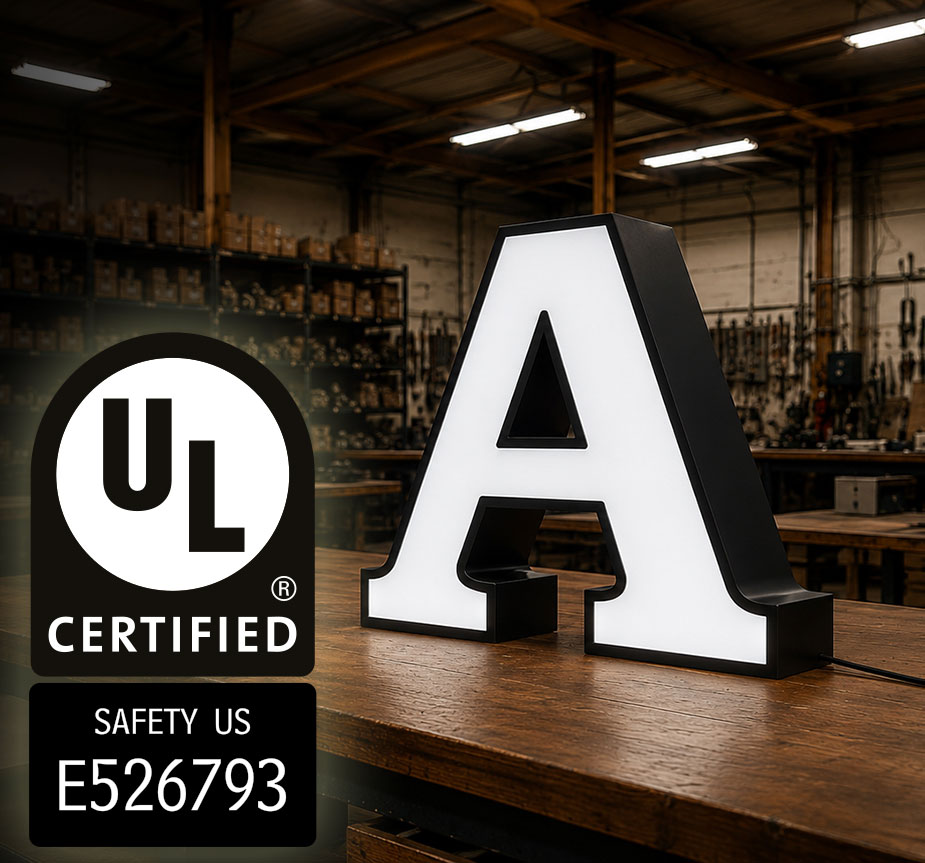
UL 48Listed & Labeled
Electric Sign
Short answer: no. UL-listed parts inside a sign, an LED module, a power supply, don’t automatically make the finished sign UL-listed. An inspector checks for a UL label on the assembled sign itself, and that label only exists if the whole sign, wired together the way it ships, was tested and certified as one unit. This is one of the most common surprises we run into on quote calls, usually from a business owner who bought a sign, or had a shop build one, using parts that were individually UL-listed, and then failed the electrical inspection anyway. The parts were fine. The assembled sign was never evaluated as a unit, and that’s what UL listing actually certifies.
We manufacture UL-listed channel letter signs and ship them nationwide, and this exact confusion, listed parts versus a listed sign, comes up often enough that it’s worth walking through clearly: what the label certifies, why “built from listed components” isn’t the same claim, the real ways this trips people up during inspection, how to verify before you order, and what’s actually at stake beyond a failed inspection.
UL Listing 101: What the Label Actually Certifies
UL, Underwriters Laboratories, tests products against published safety standards and issues a listing when a product passes. For signs, the relevant standard is UL 48, which covers electric signs as complete, assembled units, not the individual parts that go into them.
That distinction is the entire issue. UL 48 testing evaluates the sign as it will actually exist on a building: the LEDs or neon, the power supply, the wiring between them, the housing, the raceway or mounting method, all wired together the way the manufacturer intends to ship it. The test checks things like whether the wiring gets hot enough to be a fire risk under normal operation, whether the enclosure adequately protects the electrical components from weather, whether the assembly meets clearance and grounding requirements, and whether the whole thing holds up under the electrical load it’s rated for.
When a sign passes, it gets a UL label, usually a small metal or vinyl tag affixed somewhere on the housing, and that label is tied to a specific listing on file with UL for that manufacturer’s design. It’s not a generic seal you can move from one sign to another. It certifies that this specific assembled product, built by this manufacturer, meets the standard, and an electrical inspector checking your sign is looking for that label on the sign, on-site, not for a stack of component data sheets.
The listing lives with the assembled, as-built sign, not with any single part inside it.
This matters because it explains why a sign can be built entirely from legitimately UL-listed parts and still not carry a UL listing itself. Nobody submitted the finished assembly for testing. The parts are safe on their own terms. The combination has never been evaluated.
Listed Components vs. a Listed Sign
Here’s the exact confusion that fails inspections, and it’s an honest one, because it sounds like it should work: a shop builds a sign using a UL-listed LED module, a UL-listed power supply, and UL-rated wire, and reasonably figures the finished sign is covered because every piece going into it is.
It isn’t, and the reason comes back to what UL 48 actually tests. Two identical LED modules from two identical power supplies can behave completely differently once they’re wired together inside a housing, depending on wire gauge and routing, how much heat builds up in an enclosed space, whether the power supply is properly matched to the load, and how the whole assembly is grounded and sealed against moisture. UL 48 testing is checking that specific combination, in that specific housing, under real operating conditions. A parts list doesn’t answer any of those questions. Only testing the finished product does.
This is also where “UL-recognized” versus “UL-listed” adds a second layer of confusion. A UL Recognized Component mark (you’ll sometimes see it as “UL-R”) means a part is approved for use inside a larger UL-listed assembly, but it isn’t, by itself, a finished-product listing. It’s a building block, not a certificate. A power supply or LED module can carry a Recognized Component mark and be completely legitimate, while the sign built around it still needs its own UL 48 listing to be code-compliant on the building. Confusing a component mark for a product listing is an easy mistake, and it’s one that shows up on failed inspections more often than outright counterfeit UL labels do.
The practical upshot: when you’re evaluating a sign, or a sign manufacturer, “we use UL-listed parts” and “this sign is UL-listed” are two different claims, and only the second one is what an electrical inspector signs off on.
Why This Trips Up Inspections: Real Failure Scenarios
The gap between listed parts and a listed sign doesn’t stay theoretical, it shows up as a failed inspection, and it tends to follow a few consistent patterns.
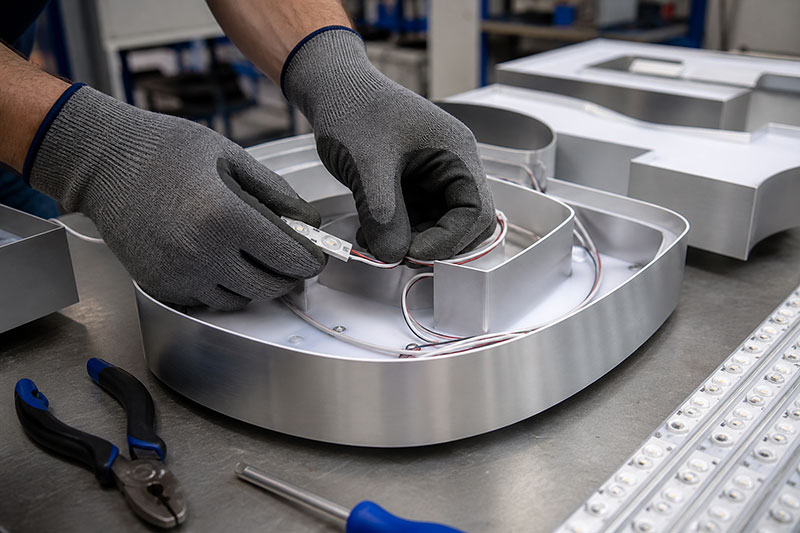
The common thread across all four: the listing lives with the assembled, as-built sign, not with any single part in it, and anything that changes what “as-built” means, a missing label, an undocumented swap, a field modification, breaks the chain an inspector is checking.
What to Verify Before You Order
The good news is that verifying a manufacturer’s UL listing before you order is straightforward, and it’s worth doing regardless of how reputable the company seems, because the failure mode here is rarely intentional fraud, it’s usually a smaller shop that genuinely doesn’t have its own listing and isn’t being upfront about what that means for you.
✓
✓
✓
✓
✓
If a manufacturer hesitates on any of these, can’t produce a file number, or answers “we use listed parts” when you ask about the sign itself, that’s the moment to get clarity before you commit to a design, not after the sign shows up and fails inspection.
Landlord, Insurance, and Code Consequences of Skipping It
A failed electrical inspection is the immediate, visible consequence, but it’s not the only one, and the others tend to surface later, when they’re harder to fix quickly.
You can’t legally energize the sign until it passes. This is the direct code consequence: most jurisdictions require electrical sign inspections to sign off before permanent power is connected, following NEC Article 600, the section of the National Electrical Code that specifically governs electric signs and outline lighting. An unlisted sign, or one that fails inspection for a listing gap, sits dark, sometimes for weeks, while the compliance issue gets sorted out, which is a real cost for a business counting on that sign for a grand opening or a seasonal push.
Landlords, especially in multi-tenant centers, often require proof of UL listing as part of their own sign approval before they’ll allow installation at all. This is separate from the city’s inspection. A landlord’s sign criteria document frequently spells out UL compliance explicitly, because the property owner is on the hook for the building’s overall code compliance and doesn’t want a tenant’s non-compliant sign creating a problem during the property’s own inspections or insurance reviews.
Insurance is the consequence that doesn’t show up until something goes wrong. If an unlisted or improperly modified sign is involved in an electrical fire, an insurer investigating the claim will look at whether the sign met code, and a listing gap, especially one nobody disclosed at the time of installation, can complicate or reduce a claim. This is the same liability logic that applies to skipping a permit entirely: the inspection process, and the listing it’s checking for, exists because it was actually verified as safe, not just assumed to be. When that verification never happened, the business owner is the one holding the risk if something fails.
Re-doing the work costs more than doing it right the first time. A sign that fails inspection for a listing issue usually has three paths forward: swap in a properly listed replacement sign, which means eating the cost of the first one; attempt a field correction that restores compliance, which isn’t always possible depending on what’s wrong; or, in some cases, have the manufacturer submit the specific assembly for UL evaluation after the fact, which is slower and more expensive than starting with a listed product. None of these are ever cheaper or faster than confirming listing status before you order.
Where This Fits Into Ordering a New Sign
UL listing is one of a handful of things worth confirming before fabrication starts, alongside the size and illumination questions covered in our guide on sign permitting (the electrical sub-permit process ties directly into this: an inspector reviewing your electrical permit is the same inspector checking for the UL label). If you’re comparing manufacturers, ask about UL listing status the same way you’d ask about lead time or warranty coverage, it’s a direct question with a direct, verifiable answer, and any manufacturer worth ordering from should be able to give you a file number without hesitation.
Every channel letter sign we build carries its own UL listing as a finished, assembled product, not a claim based on the parts inside it, and we can provide the file number before you order. Start with a free quote and ask us directly, or build your design in our online sign designer and we’ll confirm listing and code details for your specific sign before anything goes into production.
Frequently Asked Questions
Ready to Order
ORDER A SIGN THAT ACTUALLY PASSES INSPECTION
UL listing on a channel letter sign isn’t about the parts, it’s about the finished, assembled product being tested and certified as a whole, and it’s a direct question with a direct answer any manufacturer should be able to give you before you order. Request a free quote and we’ll confirm our UL listing and file number for your project. Already have a design in mind? Build it in our online sign designer and we’ll flag any code or listing details worth checking before anything goes into production.